

Commercial leaders depend on performance measures across brands, territories, channels, customers, payers and products. Yet the same KPI can produce different numbers in an executive scorecard, a brand dashboard and a sales report. The label may be identical; the filters, data cut-off, hierarchy, calculation logic or inclusion rules are not.

This is more than a reporting inconvenience. Teams spend review meetings reconciling numbers instead of acting on them. Accountability becomes negotiable, confidence in forecasts declines, and new analytics or AI solutions inherit conflicting definitions. The answer is not another dashboard. It is a governed system for defining, producing and changing commercial KPIs.
Why commercial KPIs drift
KPI inconsistency usually begins upstream of reporting. Measures are often created within individual projects to answer an immediate question. Sales, marketing, market access, and finance may each define performance from their own perspective. Over time, local logic becomes embedded in spreadsheets, data pipelines, and visualization tools.
The problem intensifies in life sciences because commercial data comes from multiple internal and external sources. CRM activity, third-party market data, customer master records, product hierarchies, payer data and contracting information update at different frequencies and levels of detail. A territory realignment, CRM migration or customer-master change can alter results even when the KPI formula appears unchanged.
Ownership is another fault line. The business may own the intent, data teams the transformation logic and technology teams the reporting platform, but no one owns the KPI end to end. Without explicit decision rights, differences are resolved repeatedly rather than systematically.
What a governed KPI must contain
A KPI definition should be usable by both business and technical teams. At minimum, it needs a clear business purpose; the decision it supports; a precise formula; population and exclusion rules; time period and grain; approved data sources; hierarchy and attribution rules; refresh frequency; accountable owner; data steward; validation thresholds; and a change history.
The definition must also connect to implementation. Source-to-report traceability should show how underlying data is acquired, standardized, transformed and presented. A business glossary without technical lineage creates documentation, not control. Technical lineage without business meaning produces consistent calculations that may still answer the wrong question.
A practical operating model for KPI governance
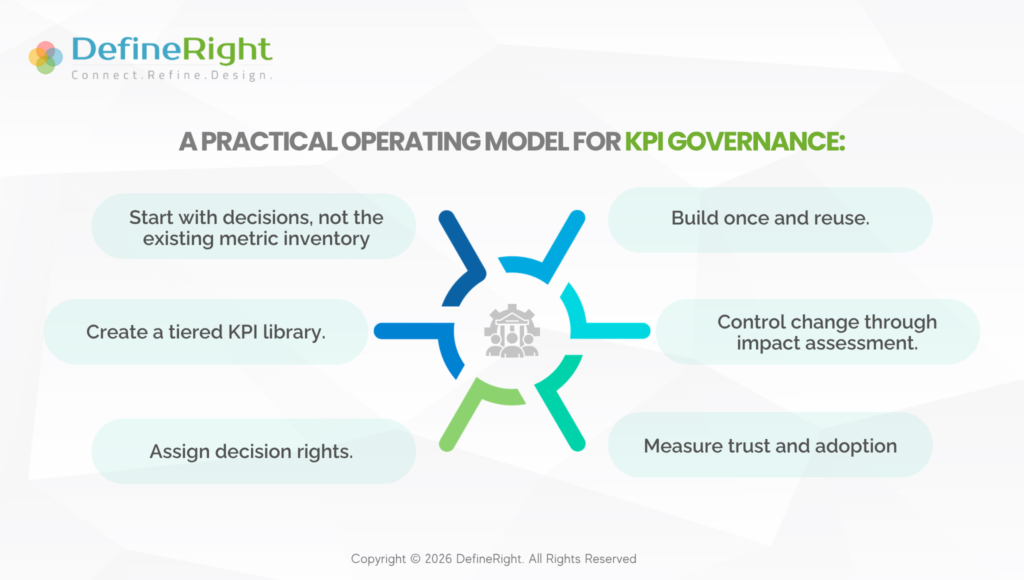
Start with decisions, not the existing metric inventory. Identify the recurring commercial decisions leaders need to make, such as reallocating field effort, assessing brand health, adjusting channel investment or managing launch risk. This separates decision-critical measures from metrics that are merely available.
Create a tiered KPI library. Enterprise KPIs should remain stable and comparable across brands and markets. Functional KPIs can support sales, marketing, market access or pricing decisions. Diagnostic measures explain movement in the higher-level KPIs. Organizing measures this way reduces metric proliferation while preserving the detail needed for action.
Assign decision rights. A commercial analytics or data-governance council should approve enterprise definitions and resolve cross-functional conflicts. Each KPI needs a business owner accountable for meaning, a data owner accountable for quality and availability, and a technical custodian responsible for consistent implementation. The governance forum should focus on exceptions and changes rather than re-approving routine reporting.
Build once and reuse. Approved logic should sit in a governed data or semantic layer wherever feasible, rather than being recreated in every dashboard. Certified datasets, reusable calculation rules and standard reporting components make consistency scalable. They also make self-service analytics safer because users begin with trusted measures.
Control change through impact assessment. Changes to territory, customer or product hierarchies, source systems and business rules should trigger a review of affected KPIs, reports, and downstream processes. Definitions need effective dates and version histories so leaders can distinguish a true performance movement from a measurement change.
Measure trust and adoption. Governance is working when reconciliation effort falls, certified KPI usage rises, issues are resolved faster, and leadership reports require fewer manual adjustments. These operational indicators are as important as the completeness of the KPI catalog.
How this changes commercial performance reviews
Consider territory performance. A governed measure specifies the alignment version, account-attribution rule, sales basis, reporting period and handling of restatements. Without those controls, two valid-looking dashboards can tell different stories.
For omnichannel engagement, governance standardizes what counts as an interaction, how HCP identities are matched, how duplicate events are handled, and which time window applies. For market access, it clarifies source refresh cycles, payer and plan hierarchies, coverage-status rules and aggregation methods. In each case, consistency comes from shared rules and ownership, not from visual standardization alone.
Governance should accelerate decisions, not add bureaucracy
Effective KPI governance is proportional. High-impact, cross-functional measures require formal approval and tighter controls; local exploratory metrics can follow lighter standards. A simple intake process, clear approval thresholds and reusable templates keep governance from becoming a bottleneck.
The goal is not to eliminate every variation. It is to make variations intentional, visible, and explainable. When commercial teams know which measures are authoritative, where they came from and who can change them, performance conversations shift from debating data to deciding action.
From metrics to a trusted decision system
Consistent commercial performance measures require more than KPI workshops or reporting automation. They depend on an integrated approach spanning business requirements, governance, data foundations, lineage, reporting standards and change management.
DefineRight helps life sciences organizations establish this foundation: from commercial data-landscape assessments and KPI-definition workshops to ownership models, source-to-report traceability, reporting frameworks and executive dashboards. The result is a more trusted view of performance, less reporting rework and a scalable base for analytics and AI-enabled decision support.