

R&D spending in pharmaceutical and biotechnology companies is rarely straightforward. Clinical development programs involve multiple trials, external vendors, research sites, internal teams, and milestones, each contributing to the overall investment. When actual expenditure differs from the approved budget, understanding the reason requires more than reviewing financial reports.

The real challenge is connecting financial variances to what is happening across clinical trial programs.
An R&D budget variance is not simply a financial discrepancy. It can indicate changes in trial execution, resource allocation, timelines, or portfolio priorities. Without visibility into these connections, organisations risk making financial decisions based on incomplete operational information.
Why R&D Budget Variances Occur
Clinical trial budgets are developed using assumptions about enrolment, site activation, patient visits, vendor costs, study duration, and resource requirements. As trials progress, these assumptions can change.
Several factors commonly contribute to budget variances:
- Patient enrolment: Slower-than-expected recruitment can extend trial timelines and increase site maintenance and monitoring costs.
- Protocol amendments: Changes to study design, eligibility criteria, or assessment requirements can introduce additional operational and financial commitments.
- Site activation delays: Delayed regulatory approvals or site readiness can shift expenditure across reporting periods.
- Vendor costs: Changes in scope, service volumes, or contract terms can increase external expenditure.
- Resource requirements: Extended timelines or overlapping trial activities can create additional demand for clinical operations, data management, and other specialised teams.
These factors rarely affect only one financial line. A delay in patient recruitment, for example, may influence monitoring schedules, vendor commitments, internal resource utilisation, and the overall study completion date.
Understanding the underlying operational cause is therefore essential to interpreting the financial impact.
Connecting Budget Variances to Individual Trial Programs
In organisations managing multiple clinical programs, R&D expenditure is often reviewed at an aggregated level. Finance teams may have visibility into total spending across a therapeutic area or development portfolio, while clinical teams manage individual trials through separate operational systems and reports.
This creates a disconnect.
A portfolio may appear to be within its approved budget even when certain trials are experiencing significant cost overruns. Similarly, an individual program may show underspending because recruitment or site activation has fallen behind schedule.
Connecting financial information with trial-level performance helps explain these differences.
For example, consider a clinical development portfolio with three ongoing trials:
- Trial A is exceeding its budget due to higher-than-expected patient recruitment and monitoring costs.
- Trial B is underspending because site activation has been delayed.
- Trial C is progressing as planned and remains within its approved budget.
Looking only at the combined R&D expenditure may suggest that the portfolio is performing reasonably well. However, the underlying picture is different. Trial A requires closer cost monitoring, Trial B carries a potential future spending shift, and Trial C is progressing according to plan.
Without trial-level visibility, these differences can remain hidden within consolidated financial reports.
Why Financial and Operational Data Must Work Together
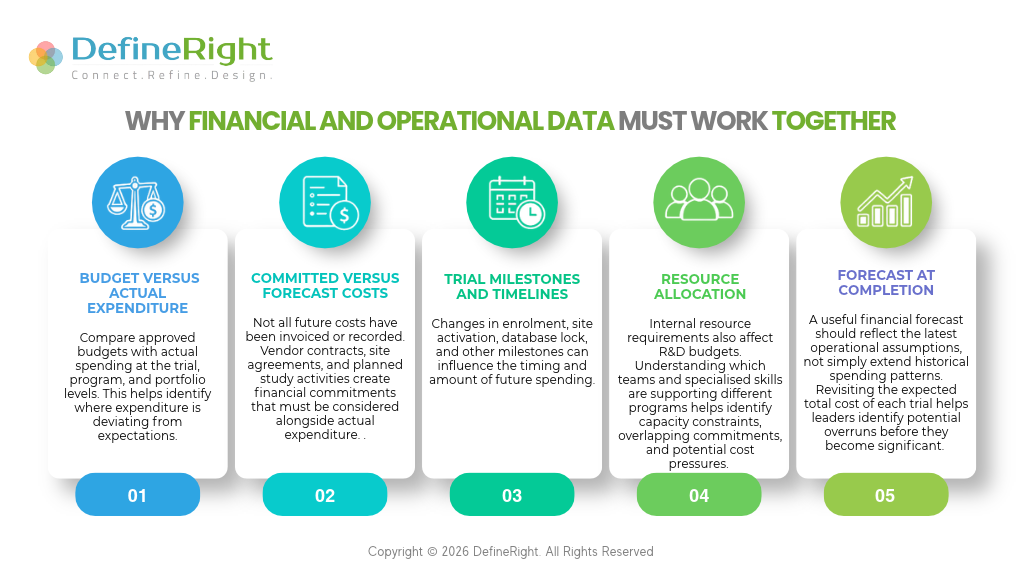
Effective R&D budget management requires finance and clinical development teams to work with connected information.
Financial data explains how much has been spent, committed, and forecast. Operational data explains why expenditure is changing and what may happen next.
Moving from Variance Reporting to Better Decisions
Identifying a variance is only the first step. The greater value comes from understanding its implications and determining what action is required.
A consistent variance review should establish three things:
- What changed? Identify the difference between planned and actual expenditure.
- Why did it change? Connect the variance to trial milestones, operational activities, resource requirements, or vendor commitments.
- What happens next? Assess the impact on future spending, study timelines, and portfolio priorities.
This approach also helps distinguish between temporary timing differences and genuine cost increases.
For instance, underspending caused by delayed site activation does not necessarily represent a saving. The expenditure may simply move into a later reporting period, potentially alongside an extension of the trial timeline.
Similarly, an overspend may reflect accelerated trial execution rather than poor cost control. The important question is whether the additional investment is justified by the program’s objectives and expected outcomes.
Building a Connected View of R&D Financial Performance
As clinical portfolios grow, managing R&D budgets through disconnected spreadsheets and periodic financial reports becomes increasingly difficult.
Organisations need reliable data, consistent reporting structures, and better connections between financial planning and clinical operations.
Integrated dashboards, financial analytics, and scenario planning can help bring trial budgets, actual expenditure, commitments, milestones, and forecasts into a more consistent decision-making view.
This gives finance and clinical development leaders a stronger basis for assessing the financial implications of changing trial priorities, resource constraints, and execution timelines.
Ultimately, understanding R&D budget variances is about more than explaining differences between planned and actual spending. It is about understanding how individual trial programs contribute to the financial performance of the wider development portfolio.
When financial and operational information are connected, organisations can move beyond retrospective reporting towards more informed forecasting, resource allocation, and portfolio-level decisions.