
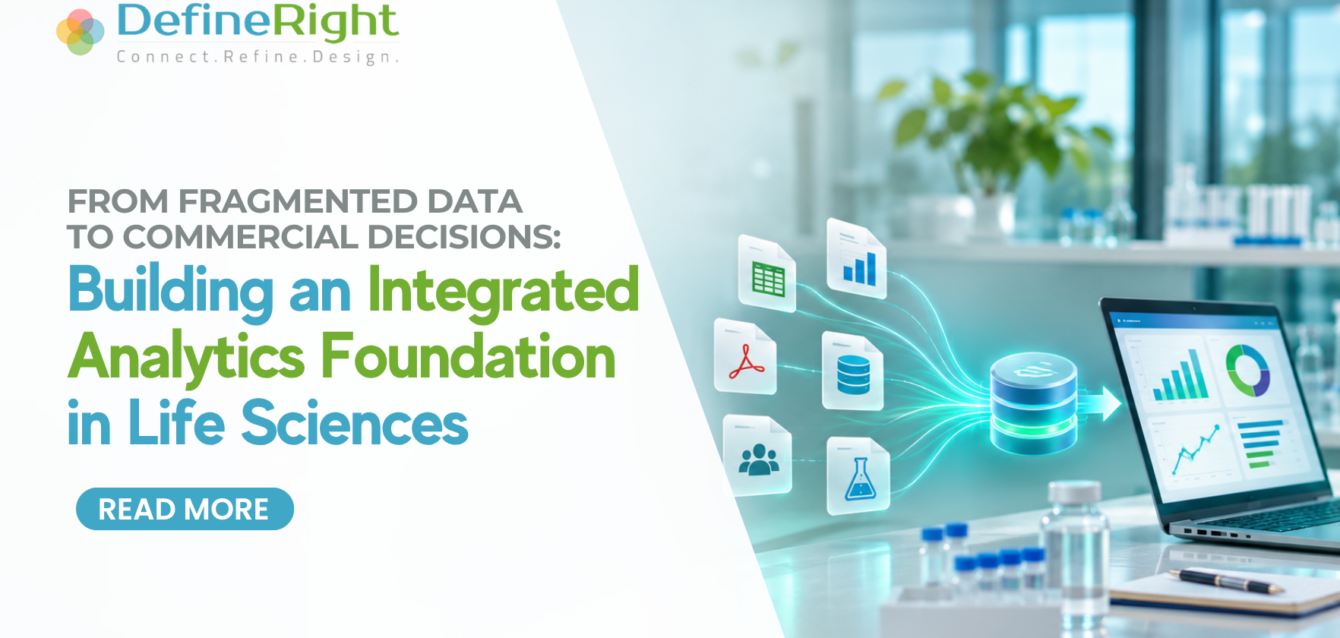
Life sciences commercialization has become increasingly complex. Pharmaceutical and biotechnology companies must coordinate decisions across brand strategy, sales operations, market access, patient services, finance, and commercial analytics. Each function generates substantial data, yet the ability to translate that information into timely, coordinated business decisions remains a persistent challenge.

The problem is rarely an absolute shortage of information. Companies often have sophisticated analytics platforms, extensive reporting capabilities, and access to multiple commercial data sources. The greater challenge lies in connecting these sources, establishing consistent business definitions, and ensuring that insights reach decision-makers in a form they can act upon.
Effective commercialization requires more than visibility into performance. It requires an integrated foundation that connects data, decisions, and execution.
1. The Commercial Data Fragmentation Challenge
Life sciences companies work with a diverse collection of internal and external data sources:
- Sales and prescription data: Tracking product demand, prescribing trends, territory performance, and market share.
- Customer and engagement data: Capturing healthcare professional interactions, channel engagement, and field-force activities.
- Market access data: Understanding formulary coverage, payer restrictions, reimbursement conditions, and patient access barriers.
- Patient services data: Monitoring enrollment, treatment initiation, adherence support, and discontinuation patterns where appropriate data is available.
- Financial and operational data: Evaluating revenue performance, commercial expenditure, forecasts, and resource allocation.
These datasets frequently reside in different systems, are refreshed at different intervals, and follow different definitions or hierarchies.
For example, a brand team may evaluate performance by therapeutic area and market segment, while sales operations uses territory-level metrics and market access teams focus on payer coverage and access restrictions.
Each perspective is valuable. However, without consistent definitions and an integrated analytical view, the organization risks making decisions based on incomplete or conflicting interpretations of commercial performance.
The result is not simply inefficient reporting. It can directly affect commercial planning, resource deployment, and the speed of response to market changes.
2. Connecting Commercial Performance Across Functions
Consider a pharmaceutical company experiencing slower-than-expected uptake of a recently launched therapy.
Several explanations may be possible:
- Prescriber awareness and engagement remain below expectations.
- Formulary access or prior authorization requirements constrain treatment initiation.
- Field-force coverage does not adequately reflect prescriber opportunity.
- Patient onboarding or treatment continuation presents operational challenges.
- Competitive activity has changed prescribing behavior.
Traditional reporting may identify a decline in sales performance without adequately distinguishing among these contributing factors.
An integrated commercial analytics approach connects relevant information across functions to develop a more complete picture.
For instance, combining prescribing trends, field engagement, payer coverage, and appropriately governed patient-services insights may help determine whether underperformance is primarily associated with customer engagement, market access, or patient journey challenges.
This distinction matters because each explanation calls for a different intervention.
Better analytics does not simply identify where performance is falling short. It helps commercial leaders determine which actions are most likely to address the underlying issue.
3. Establishing Consistent KPIs and Business Definitions
Commercial analytics can only support reliable decisions when the underlying performance measures are clearly defined.
In many organizations, different functions maintain their own KPIs, reporting logic, and data transformations. Even common metrics such as market share, new patient starts, prescriber reach, or sales-force effectiveness may be calculated differently across teams.
These inconsistencies generate reconciliation exercises and reduce confidence in management reporting.
A stronger KPI governance framework establishes:
- Standardized definitions for critical commercial measures.
- Clear ownership of metrics and their underlying data sources.
- Consistent customer, product, geography, and organizational hierarchies.
- Documented calculation logic and refresh frequencies.
- Agreed processes for resolving data discrepancies and approving changes.
The objective is not to eliminate function-specific analytics. Different teams will continue to require different analytical perspectives.
Instead, it is to ensure that those perspectives are built upon a common foundation.
When brand, sales, market access, and finance teams operate with consistent measures, leadership discussions can shift from reconciling numbers to evaluating performance and making decisions.
4. Moving From Descriptive Reporting to Decision-Oriented Analytics
Commercial reporting has traditionally focused on explaining what happened.
Dashboards can show sales trends, prescribing volumes, territory performance, and customer engagement. While this visibility remains essential, it does not automatically establish what the organization should do next.
A more mature analytics approach progresses through three levels:
Descriptive analytics: What happened?
Identifying changes in market share, prescribing behavior, territory performance, customer engagement, or patient access.
Diagnostic analytics: Why did it happen?
Examining relationships between performance outcomes and possible contributing factors such as payer restrictions, engagement gaps, competitive developments, or changes in customer behavior.
Predictive and prescriptive analytics: What could happen next, and how should we respond?
Using forecasting, scenario analysis, and optimization to evaluate potential outcomes and compare possible commercial interventions.
For example, rather than merely identifying underperforming territories, an analytics capability may help commercial operations assess whether adjustments in field deployment, targeting, or channel strategy could improve coverage.
The effectiveness of these recommendations depends on data quality, analytical assumptions, and business validation. Predictive outputs should support—not replace—commercial judgment.
The important shift is from producing more reports to developing analytical capabilities around specific business decisions.
5. Connecting Analytics With Commercial Planning and Execution
Even high-quality insights deliver limited value if they remain disconnected from operational processes.
Commercial organizations need mechanisms to translate analytical findings into actionable plans.
Consider a scenario where analytics identifies a segment of high-potential prescribers with low engagement.
The next steps may require coordination among several functions:
- Commercial analytics validates the opportunity and prioritizes the segment.
- Brand and sales leadership evaluate the proposed intervention.
- Sales operations adjusts targeting or territory deployment.
- Marketing aligns appropriate content and engagement channels.
- Performance management tracks the intervention against defined KPIs.
Without coordinated workflows, the original insight may remain an observation rather than a business improvement initiative.
Organizations should therefore establish clear decision rights, accountability, and feedback mechanisms around analytics-driven actions.
This also enables continuous learning. Results from commercial interventions can be incorporated into subsequent planning cycles, helping teams refine targeting, resource allocation, and investment decisions.
6. Building the Technology and Data Foundation
Supporting integrated commercial analytics requires a data and technology architecture aligned with commercial business needs.
Depending on the organization’s existing landscape, this may involve:
- Integrating relevant internal and external commercial data sources.
- Establishing governed data models and common business definitions.
- Implementing data-quality controls, lineage, and access management.
- Modernizing data pipelines and analytics infrastructure.
- Developing reusable analytical datasets for commercial functions.
- Introducing AI and advanced analytics where they address defined business needs.
Cloud-based data platforms and modern analytics tools can support these capabilities, but technology selection should follow an assessment of existing systems, data maturity, and decision-making requirements.
A large-scale platform transformation is not always necessary. Organizations can often begin with targeted improvements to high-priority data flows, KPI governance, or analytical workflows.
The critical consideration is whether the technology investment improves the reliability, accessibility, and business usefulness of commercial information.
7. A Practical Roadmap for Commercial Analytics Transformation
Life sciences companies can approach commercial analytics transformation through four connected activities.

This phased approach creates opportunities to demonstrate measurable value without making transformation dependent on a single large technology implementation.
Conclusion: Commercial Analytics as a Business Decision Capability
The next stage of life sciences commercial analytics maturity will not be defined simply by the volume of available data or the sophistication of reporting platforms.
It will be determined by how effectively organizations connect information across functions, establish trusted performance measures, identify the drivers of commercial outcomes, and translate insights into coordinated action.
Commercial analytics creates its greatest value when it becomes part of how the business makes and executes decisions—not simply how it monitors performance.
For pharmaceutical and biotechnology companies, building this capability requires a combination of domain understanding, data governance, technology enablement, and operational alignment.
At DefineRight, our approach to commercialization data and analytics focuses on connecting business requirements with the underlying data, processes, and technology capabilities. By addressing fragmentation and strengthening decision support across commercial functions, we help life sciences organizations build a more integrated and actionable foundation for commercialization.