

Resource requirements change constantly across portfolio programs, non-portfolio projects, and day-to-day operations. A program accelerates, a milestone slips, a specialist becomes unavailable, or an urgent BAU request competes with planned work. Each change affects whether the organization has the capacity and capabilities to deliver.

Yet resource decisions often rely on spreadsheets, fragmented project plans, and managers’ knowledge of who might be available. Headcount is visible; actual capacity is harder to establish. Teams discover shortages late, while available resources elsewhere remain overlooked.
AlineRight, DefineRight’s capacity intelligence platform for life sciences, connects requirements, capacity, skills, and allocation. It combines resource visibility, scored recommendations, governed workflows, and an AI bot to help teams identify constraints and act on them.
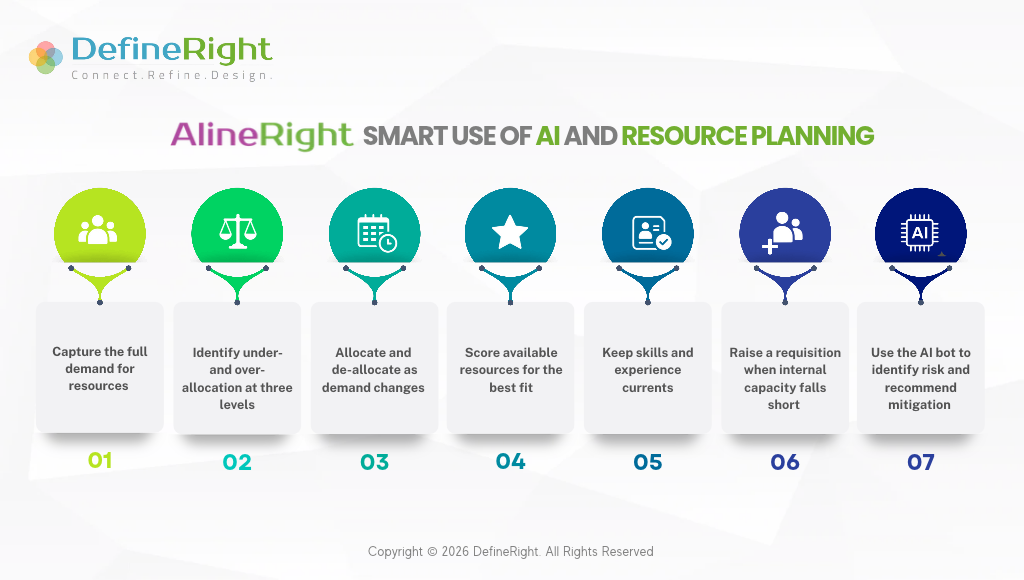
Capture the full demand for resources
A credible resource plan starts with a complete view of work. Portfolio programs represent only part of the demand placed on employees. Non-portfolio projects, operational responsibilities, and ad hoc business-as-usual activities compete for the same capacity.
AlineRight ingests requirements for both portfolio and non-portfolio projects, including ad hoc BAU work. This gives planners a broader basis for assessing resource needs across the organization.
For example, an employee may support a strategic program while also contributing to a system implementation, a process improvement initiative, and an urgent operational request. If only the program assignment is captured, the employee’s apparent availability will be overstated.
Including these requirements helps teams distinguish between capacity that appears available and capacity that can realistically be committed.
Identify under- and over-allocation at three levels
An organization can have enough people overall and still face a critical delivery constraint. Capacity may sit in one team while another lacks the specific role needed to meet a milestone.
AlineRight identifies under- and over-allocation at the role, resource, and program levels.
At the role level, planners can see whether demand for a particular capability exceeds available capacity. At the individual resource level, they can identify employees carrying excessive commitments or those with room for additional assignments. At the program level, they can assess whether staffing matches demand.
These views support different decisions. A role shortage may justify recruitment or capability development. Individual overload may require redistribution. A program gap may call for reassignment or a change in priorities.
Together, they make the source of a capacity problem easier to establish.
Allocate and de-allocate as demand changes
Resource planning requires ongoing adjustments. Keeping someone assigned after demand has reduced can conceal capacity that another program urgently needs.
AlineRight allows teams to allocate and de-allocate resources to programs based on demand. Managers can revise assignments as requirements change, keeping allocations aligned with current priorities.
Consider a delayed project that temporarily reduces demand for a specialist. Another program may need that capability during the same period. Visibility into both requirements allows managers to evaluate a reassignment. AlineRight provides the resource information and allocation capability needed to make that adjustment explicit and actionable.
Score available resources for the best fit
Knowing who has available time does not establish who is suitable for the work. A role may require particular skills and experience, while the strongest candidate may already have commitments elsewhere.
AlineRight recommends best-fit resources for a role by providing a score for each available resource considered for that role. This gives managers a structured comparison of candidates alongside their capacity and existing assignments.
The scores help narrow the search and make allocation discussions more specific. Managers can assess the recommended fit, review relevant experience, and consider the implications of selecting one person over another.
This is especially useful when suitable employees sit outside the requesting manager’s immediate team. The organization can identify internal capability more systematically instead of relying on personal networks or repeatedly approaching the same specialists.
Keep skills and experience current
Resource recommendations depend on the quality of employee information. A profile created at onboarding can quickly become outdated as people complete projects, develop skills, and gain experience.
AlineRight allows employee skills and experience to be updated in the system. Maintaining these records helps resource decisions reflect current capability.
Employees may develop expertise through different programs, functions, systems, or operational responsibilities. That experience can materially affect their suitability for a new assignment.
Updated profiles make these capabilities visible to planners. They also help avoid overlooking employees who have developed relevant expertise since their previous assignment or assessment.
Raise a requisition when internal capacity falls short
Some requirements cannot be met through reassignment. The organization may lack the necessary capability, or suitable employees may be fully committed during the required period.
AlineRight allows teams to raise a requisition for a new resource when the organization cannot fulfil the requirement internally.
Connecting the requisition to an identified demand makes the request more concrete. Managers can explain the role required, the capacity gap, and why existing resources cannot cover it.
This supports a more disciplined hiring discussion. Recruitment follows an assessment of internal options, with a clearer connection between the requested resource and the work that needs to be delivered.
Use the AI bot to identify risk and recommend mitigation
Resource information becomes more valuable when teams can quickly understand its implications for delivery.
AlineRight’s AI bot calls out programs at risk because of resource availability. It also supports mitigation by recommending resources available from other programs.
For example, a program approaching a milestone may lack sufficient specialist capacity. The bot can highlight the risk and recommend available resources elsewhere for managers to evaluate.
This shortens the path from identifying a shortage to considering a response. Leaders can review the suggested resources, assess competing commitments, and decide whether reassignment is appropriate.
By bringing requirements, allocation, employee capability, requisitions, and AI-assisted mitigation into one planning process, AlineRight helps teams address practical questions: Where are we short? Who can take the work? What must change? When do we hire?
The result is a clearer basis for resource decisions as portfolio priorities, non-portfolio projects, and operational demands evolve.