

Process Excellence in Life Sciences Finance
Life sciences finance teams operate in an environment where speed, accuracy and control must coexist. Yet many critical processes still depend on spreadsheets, email approvals, shared folders and knowledge held by a few individuals. The work may get completed, but often through repeated follow-ups, manual reconciliations and last-minute interventions.

The real issue is not the spreadsheet itself. It is the unmanaged handoff around it: who supplies the data, which version is current, what review is required, why an adjustment was made and whether the same control was applied consistently. Process excellence replaces this fragile coordination with controlled, visible and repeatable workflows.
Where manual handoffs create risk
Finance processes cut across FP&A, tax, treasury, business units and technology teams. A monthly close, forecast refresh, tax provision or management report can involve multiple source systems, calculations, reviews and approvals. When these steps are coordinated manually, small delays compound quickly.
Teams spend time collecting and validating data instead of interpreting it. Reviewers receive files without sufficient context. Corrections create parallel versions. Exceptions remain buried in email threads. Leadership reporting becomes a periodic production exercise rather than a reliable view of performance. The result is longer cycle times, limited traceability and a higher dependence on individual experience.
In life sciences, these weaknesses are amplified by complex entity structures, product and geography reporting, evolving portfolios, regulated processes and demanding audit requirements. A workflow must therefore do more than move a task from one person to another. It must preserve the logic, evidence and accountability behind the financial outcome.
What a controlled workflow looks like
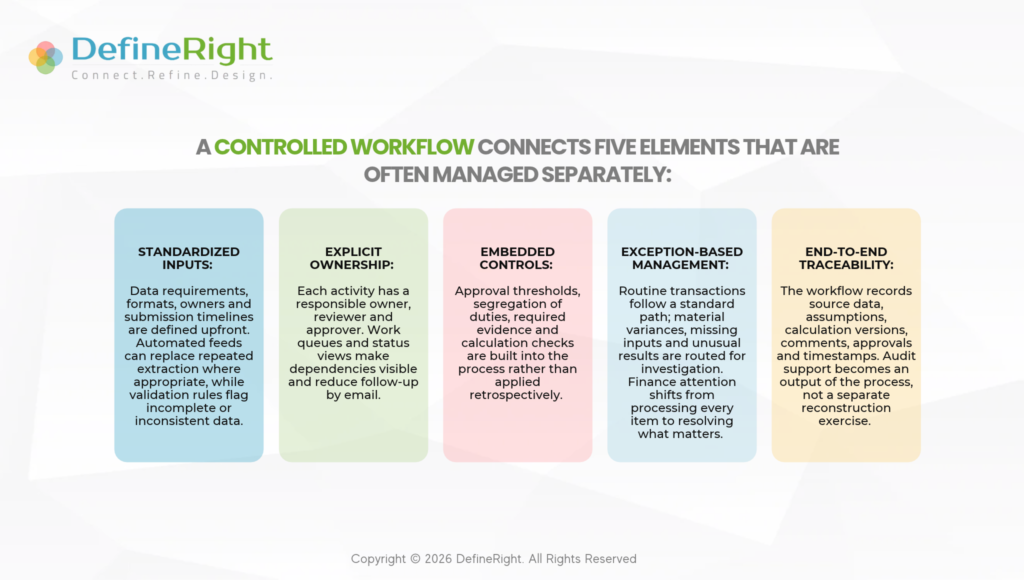
A controlled workflow brings structure and accountability to every stage of a finance process—from data submission and validation to review and approval. It connects standardized inputs, clear ownership and embedded controls, while directing attention to exceptions that require investigation. By recording the data, decisions and approvals along the way, it reduces manual follow-ups and makes each outcome easier to explain, verify and audit.
High-value opportunities in life sciences finance
The best candidates for workflow redesign combine high effort, repeated handoffs and meaningful control risk. Typical opportunities include annual income tax provision processes, amortization and depreciation calculations, budgeting and forecasting cycles, variance investigation, management reporting and treasury visibility.
For example, a spreadsheet-dependent tax calculation can be redesigned around standardized source inputs, controlled calculation logic, validation rules and automated logs. A reporting workflow can consolidate data from ERP, planning and reporting systems, apply governed KPI definitions and produce dashboards or management packs without recreating the same analysis each cycle. A budgeting process can route submissions, validations, challenges and approvals through a common workflow while preserving the assumptions behind each revision.
These improvements reinforce one another. Better workflow discipline improves data quality; trusted data strengthens analytics; and clearer analytics helps finance identify the next process constraint.
Automation should follow process clarity
Automating a poorly understood process can make errors move faster. The starting point should be a practical diagnostic: map the current process, identify handoffs and rework, document controls, assess data dependencies and distinguish genuine business requirements from historical workarounds.
The future-state design can then determine what should be standardized, simplified, automated or retained as human judgment. Technology selection should follow that design. Depending on the use case, the right solution may involve Alteryx-based calculation workflows, Power BI or Tableau reporting, Snowflake data models, Microsoft tools, an existing enterprise platform or a focused custom application. A proof of concept can test the highest-risk assumptions before a broader implementation.
Measuring process excellence
Success should be measured in operational and control terms, not only by whether a tool was deployed. Relevant indicators include cycle time, manual touchpoints, late inputs, first-pass acceptance, unresolved exceptions, reconciliation effort, report preparation time and the availability of audit evidence. Adoption also matters: a technically sound workflow has limited value if users bypass it because the experience is inconsistent or cumbersome.
The goal is not a fully touchless finance function. It is a finance function in which routine work is reliable, exceptions are visible and professional judgment is applied where it adds value.
From process execution to decision support
Moving from manual handoffs to controlled workflows changes the role of finance. Teams spend less time assembling information and more time explaining performance, testing assumptions and supporting decisions. Leaders gain faster visibility into revenue, margin, profitability, forecast accuracy, cash and business drivers. Controls become easier to demonstrate because they are part of the workflow itself.
For life sciences organizations, process excellence is therefore not simply a cost-reduction initiative. It is the operating foundation for scalable finance, stronger governance and more timely decision support. DefineRight supports this shift through process optimization, data governance, analytics, workflow automation and fit-for-purpose digital solutions.