

Why Non-Portfolio Work Must Be Included in Life Sciences Resource Planning
A clinical development portfolio can look achievable on paper. Programs have milestones, teams have assigned roles, and resource plans show enough capacity to meet demand. Yet execution tells a different story: the same people are also handling operational requests, reporting, governance activities, process improvements, and urgent work that never appeared in the portfolio plan.

This is the hidden capacity drain. When business-as-usual (BAU) and non-portfolio work are left out of resource planning, an organization can mistake unrecorded demand for available capacity. The resulting gaps affect more than individual schedules. They shape which programs can move forward, when critical skills will be needed, and whether teams can deliver on commitments.
Why portfolio plans overstate availability
Portfolio planning typically starts with programs and projects: what needs to be delivered, when, and by which roles. That is essential, but it captures only part of the workload.
In a life sciences organization, a clinical operations lead may support a study while also responding to escalations, preparing governance updates, reviewing vendor issues, and contributing to an operational initiative. A development operations specialist may divide time between planned portfolio work and a steady flow of requests from across the business. Medical affairs, commercial, finance, and data teams face similar demands alongside their planned initiatives.
These activities may be recurring, intermittent, or difficult to estimate precisely. None is optional simply because it sits outside a formal program. If a resource plan counts someone’s full capacity but omits those commitments, every subsequent decision rests on an inflated view of availability. A new initiative may appear adequately staffed when the required skills are already stretched.
The gap often becomes visible only after deadlines slip, priorities collide, or managers discover that several teams have made commitments against the same people.
The cost of work that stays invisible
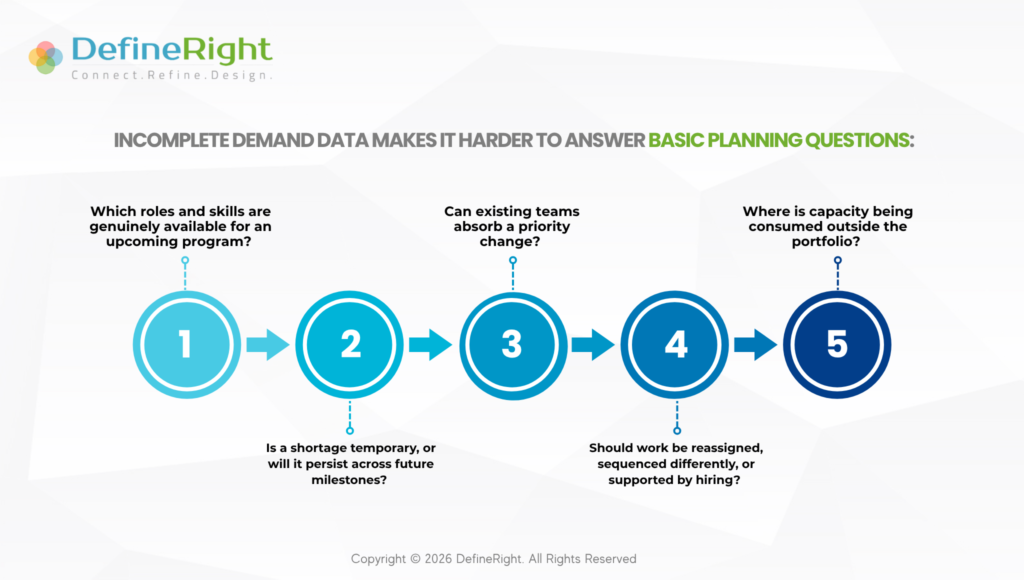
Without a shared view, these questions are often resolved through spreadsheets, emails, meetings, and local knowledge. Managers may each have a sound picture of their own teams, while leadership lacks a reliable view across functions. Staffing becomes reactive, and allocation decisions are harder to explain or revisit.
Hidden demand can also distort the signals leaders use to make longer-term decisions. Persistent overload may look like an execution problem when the real issue is that operational work was never included in the forecast. Conversely, a team may appear fully allocated in a portfolio system while having capacity that could be used elsewhere. Both situations make it harder to distinguish a genuine hiring need from a planning or allocation issue.
Plan against the full demand picture
Better resource planning begins by treating portfolio, BAU, and non-portfolio work as parts of the same demand picture. That does not require every operational task to become a fully planned project. It requires enough visibility into recurring commitments and other work to understand their effect on capacity.
Organizations can start by identifying the categories of work that consistently draw on shared resources. They can then estimate the capacity those activities consume by role, team, and planning period, refining the estimates as actual demand becomes clearer. Even a practical baseline is more useful than assuming that all time outside named projects is available.
The next step is to connect that demand to supply: available people, roles, capabilities, existing allocations, and future requirements. This makes it possible to distinguish a headcount gap from a specific skills gap, identify overload earlier, and test whether a proposed portfolio plan is executable.
For example, a team may appear to have capacity for a new study based on headcount alone. Once ongoing operational work and named-person allocations are included, the constraint may become clear: the team has enough people overall, but too little availability in a critical capability during the study’s launch window. That finding gives leaders options to assess. They might adjust timing, rebalance assignments, develop internal capability, or begin hiring before the constraint delays the work.
How AlineRight supports the decision
AlineRight™, DefineRight’s Capacity Intelligence Platform for Life Sciences, connects demand, capacity, skills, and allocation in one planning view. It brings portfolio and non-portfolio work into resource decisions so teams can see who is available, where work is concentrated, and which capabilities future plans will require.
The platform supports role and skill-based planning, demand and capacity forecasting, allocation visibility, and the identification of overload and hiring gaps. Best-fit allocation recommendations help match work with available capabilities. Governed requests and approvals make staffing decisions more visible and explainable than informal exchanges alone.
Scenario planning is particularly valuable when priorities change. If a program accelerates, a milestone moves, or a new initiative enters the portfolio, leaders can examine the likely effect on existing commitments before assigning the work. Allocation and utilization views can then help teams monitor whether the plan remains workable as demand changes.
AlineRight is designed to integrate with existing enterprise systems. Its role is to connect planning inputs and turn them into actionable capacity intelligence across the portfolio and the operational work those systems support.
From portfolio ambition to resource reality
A portfolio plan is only as credible as its view of the people needed to deliver it. BAU and non-portfolio work will continue to consume capacity whether or not they appear in the plan. Making that demand visible allows life sciences leaders to forecast more accurately, allocate scarce skills with greater confidence, and address gaps before they become execution problems.
The objective is a resource plan grounded in the full workload: one that helps organizations turn portfolio priorities into decisions their teams can carry through to delivery.