

A study accelerates its enrollment plan. Another moves its database lock. A new program enters the portfolio earlier than expected. Suddenly, several teams need additional capacity at the same time.

The immediate response is often familiar: request more headcount, expand a partner’s scope, or ask existing teams to absorb the work.
Each option can be appropriate. The challenge is knowing which one fits the demand, how quickly it can become effective, and what consequences it creates elsewhere.
For clinical development leaders, this requires a clear view of upcoming work, available skills, competing priorities, and the duration of the capacity gap. This is where the capacity intelligence perspective behind AlineRight™ becomes useful: connecting development plans with resource decisions.
First, establish whether the gap is real
A busy team does not automatically need more people. Its workload may reflect a temporary milestone peak, overlapping deadlines, avoidable rework, or an uneven distribution of responsibilities.
Before choosing a response, define the gap precisely:
- What work must be completed, and by when?
- Which roles and skills does it require?
- How much effort is needed during each period?
- What capacity is available after existing commitments?
- How long will the shortfall persist?
Consider a clinical operations team preparing for multiple study startups. Its annual staffing position may appear adequate, yet a particular month could contain more activation work than the team can deliver. Conversely, a temporary surge may look like a permanent shortage when viewed only through current utilization.
The useful unit of analysis is therefore capacity by role, skill, and time period. An organization-wide headcount total cannot reveal whether the right expertise will be available when a critical activity begins.
Hire when demand is sustained and strategically important
Hiring makes sense when the organization expects recurring demand for a capability it needs to retain internally.
A growing portfolio may require continuing clinical leadership, operational oversight, or specialist expertise across successive studies. In these situations, permanent recruitment can strengthen organizational knowledge and reduce repeated dependence on external support.
However, approval for a position does not immediately create productive capacity. Recruitment, notice periods, onboarding, and familiarization with the portfolio all affect when a new employee can contribute effectively.
The decision should therefore consider:
- Whether demand continues beyond the immediate milestone
- Whether the capability is central to the operating model
- Whether the workload supports a permanent position
- Whether recruitment can meet the required timeline
A persistent gap across several planning periods provides a stronger hiring case than a single overloaded month. If the need is immediate but enduring, temporary support may still be necessary while recruitment progresses.
Outsource when flexibility or specialist access matters
Outsourcing can help address a defined workload, a temporary peak, or a capability that is difficult to build quickly.
It can also provide flexibility when future demand remains uncertain. An organization may prefer to secure support for a specific development phase before committing to permanent capacity.
Yet external capacity comes with internal responsibilities. Teams still need to define scope, transfer knowledge, coordinate activities, review deliverables, and maintain oversight.
A partner engagement can therefore increase demand on an already stretched internal lead. Any comparison should include this retained workload.
Before outsourcing, assess whether the work is sufficiently defined, whether suitable expertise is available, and whether internal teams have the capacity to manage the engagement.
The relevant comparison is total delivery effort and cost, including coordination and oversight. A lower external rate offers limited value if unclear ownership creates repeated reviews or delays.
Reallocate when suitable capacity exists elsewhere
Reallocation can be an effective response when another study or program has slowed and the required expertise is available internally.
The opportunity becomes visible only when leaders can look across the portfolio. Individual functions may see their own shortages while remaining unaware of capacity becoming available elsewhere.
However, apparent availability needs careful examination. A person with spare hours may lack the relevant experience, have upcoming commitments, or require substantial context transfer.
Moving someone also changes the capacity position of the work they leave behind.
A sound reallocation decision considers skill fit, timing, transition effort, and the effect on both programs. It should identify which activities can move safely and which require continuity.
The aim is to use available expertise effectively while protecting the commitments already made across the portfolio.
Compare scenarios against the same development plan
Hiring, outsourcing, and reallocation should be evaluated using a common demand baseline.
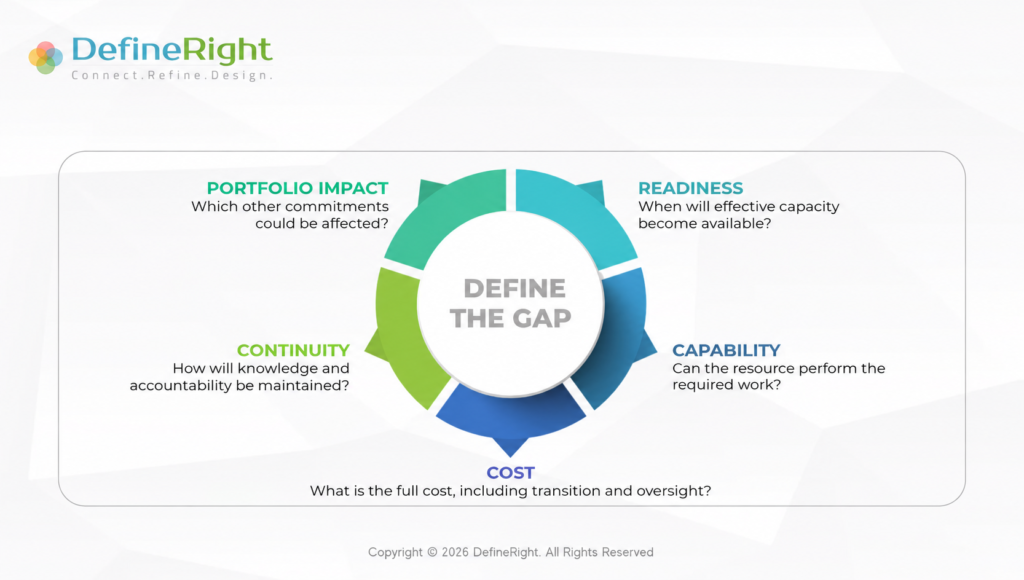
This comparison may reveal that a combination works best. Internal reallocation could cover an immediate milestone, specialist support could address a defined technical need, and hiring could resolve a longer-term capability gap.
The decision should also be tested against changing assumptions. What happens if enrollment accelerates, a milestone slips, or another program receives priority? An option that works under one forecast may become unsuitable under another.
Bring an AlineRight perspective to the decision
AlineRight’s capacity intelligence and resource planning perspective encourages leaders to connect portfolio demand, functional workload, and available capacity before committing resources.
The practical shift is from asking, “How many more people do we need?” to asking, “Which capacity response best supports this development plan?”
That requires visibility across programs and functions, with enough detail to distinguish a temporary workload peak from a sustained shortage. It also requires a shared planning basis so that clinical, operational, and finance stakeholders can discuss the same assumptions.
As timelines and priorities change, capacity decisions need to be revisited. Hiring plans, partner commitments, and internal allocations should remain connected to the work they are intended to support.
For organizations navigating these choices, AlineRight provides a capacity intelligence lens for making resource planning more deliberate. Start with the demand, locate the gap, compare the alternatives, and choose the combination that supports delivery across the portfolio.